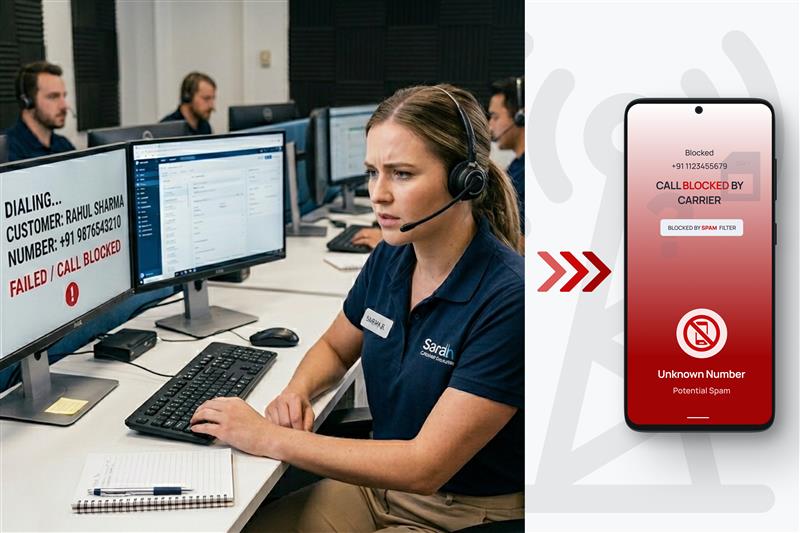
Most companies assume the problem starts when a customer sees the phone ringing and decides not to answer. In reality, many business calls never even make it that far. Telecom operators now run aggressive spam detection systems that quietly filter or block calls before they reach the user’s screen.
This means a perfectly legitimate outbound call from a bank, insurance provider, logistics company, or contact center can disappear somewhere inside the carrier network without the customer ever knowing it existed. For enterprises that depend on outbound communication, this turns into a serious operational problem.
How carrier spam detection works in India
Telecom providers like Jio and Airtel rely on large scale analytics systems to protect users from robocalls and fraud. These systems analyse patterns across millions of calls and assign reputation scores to numbers. When a number begins to look suspicious, carriers intervene.
Typical signals used by telecom spam detection include:
Sudden spikes in outbound calling volume
Low answer rates combined with repeated redial attempts
Customer complaints or manual spam reports
Missing or unclear caller identity information
Numbers that do not match known enterprise identity records
Once a number is flagged, several things can happen:
Calls may be labelled as “Spam” on the user’s screen
Calls may be silently blocked by the carrier
Calls may be downgraded in network priority
Calls may never reach the device at all
This is why many enterprises experience outbound calls going to spam even when they are fully legitimate. The telecom network simply does not trust the number yet.
Why legitimate business calls get flagged
Most enterprises operate large call infrastructures with thousands of numbers spread across vendors, diallers, and regions. From a carrier’s perspective, these numbers often look anonymous. Without a strong identity signal, the network has little context to understand whether a call is legitimate or suspicious.
This creates a common set of problems across industries:
Legitimate calls marked as spam despite customer relationships
Call blocking issues for enterprises running large outbound campaigns
Poor answer rates because customers assume unknown numbers are scams
Increasing operational costs due to repeated dialling attempts
For contact centers, this becomes a cycle. Low answer rates trigger more dial attempts, which further damages number reputation and increases the likelihood of spam tagging.
The role of caller ID reputation
Carriers do not simply block numbers randomly. They maintain evolving enterprise call reputation scores that determine how much trust a number receives on the network.
Think of it as a credit score for phone numbers.
If a number consistently shows clear identity, receives fewer complaints, and follows proper compliance guidelines, its reputation improves. If identity signals are weak or patterns resemble spam activity, reputation drops quickly.
Strong caller ID reputation management therefore becomes a critical part of modern outbound calling operations.
Compliance is now part of the trust signal
In India, regulatory frameworks have also started influencing how telecom operators treat outbound traffic.
Some of the key compliance signals carriers look for include:
TRAI 1600 series compliance for promotional and transactional calls
Adherence to TRAI regulations for outbound calling
Proper consent tracking under the DPDP Act outbound calling implications
Alignment with enterprise calling compliance standards
When these regulatory signals align with clear enterprise identity, carriers are far more likely to allow calls to pass through without interference.
The fix: verified business identity on calls
The most effective way to prevent carrier blocking is to make your identity visible and verifiable inside the telecom ecosystem.
This is where verified caller ID solutions for enterprise and branded calling platforms come into play.
Instead of a random number appearing on a user’s screen, the call can display the verified business identity associated with that number. This allows telecom networks to attach a trusted enterprise profile to the call before it reaches the user.
A branded calling solution typically enables:
Business name display on calls instead of unknown numbers
Verified enterprise identity recognized by telecom networks
Stronger carrier level trust scoring
Improved answer rates for outbound campaigns
For large organizations running high call volumes, this is no longer just a marketing feature. It becomes infrastructure for maintaining telecom trust.
Beyond display names: identity infrastructure for enterprise calling
Forward looking organizations are now treating voice identity the same way they treat domain identity for email.
Just as email uses systems like SPF, DKIM, and DMARC to verify senders, enterprise calling is moving toward structured identity layers supported by telecom networks.
This includes capabilities such as:
Enterprise caller identity verification
Business name display services integrated with carriers
Verified calling frameworks like Jio Verify
Centralized business identity management platforms
Reputation monitoring across enterprise phone numbers
The goal is simple. When a company calls a customer, the network should instantly recognize who that entity is and trust the call enough to deliver it.
Why this matters for enterprise operations
When carrier analytics silently block calls, the impact spreads far beyond missed conversations.
Organizations begin to see:
Falling connection rates across outbound campaigns
Increased dialling costs due to retries
Reduced agent productivity in contact centers
Friction in customer support and verification workflows
Lost revenue opportunities in sales and collections
Fixing business calls marked as spam is therefore not just a telecom issue. It directly affects customer experience and business performance.
The shift toward trusted business calling
Telecom networks are not trying to stop businesses from reaching customers. Their goal is to filter out anonymous and unverified traffic that often looks like spam. When a number lacks a clear business identity, carrier analytics are more likely to flag or block the call before it reaches the user.
Enterprises that adopt verified business calling and call branding solutions in India are already seeing better results. When the network can recognize the business behind the number, calls move through with stronger trust and are far less likely to be blocked.
Fourids helps businesses establish a verified identity for their outbound calls so customers see a trusted brand instead of an unknown number. By enabling business name display and verified caller ID, Fourids helps enterprises reduce spam tagging, improve answer rates, and ensure their calls actually reach customers.